Psychological Pricing: How to Price Your Products to Increase Sales Without Reducing Value?
Psychological Pricing: How to Price Your Products to Increase Sales Without Cutting Value?
Harvard Business Review research indicates that pricing strategies based on behavioral economics can boost revenues by 10% to 25%, without actually lowering a single price. At TOLQAR we help our clients design a smart pricing structure within their stores, not just random numbers based on intuition. This guide summarizes the most powerful strategies backed by scientific research.
Why Most Store Owners Price the Wrong Way?
The common assumption is that customers compare prices purely logically, while behavioral economics research (especially the work of Daniel Kahneman and Amos Tversky) has proven that humans evaluate prices based on reference points and context, not abstract mathematical calculation. Understanding this reality unlocks actual pricing tools for you, rather than just lowering the price as the sole solution to increase sales.
Pricing is not just covering costs and adding a profit margin — it is a tool that shapes how the customer perceives value, quality, and urgency.
6 Strategies Backed by Scientific Research
Strategy 1: Charm Pricing
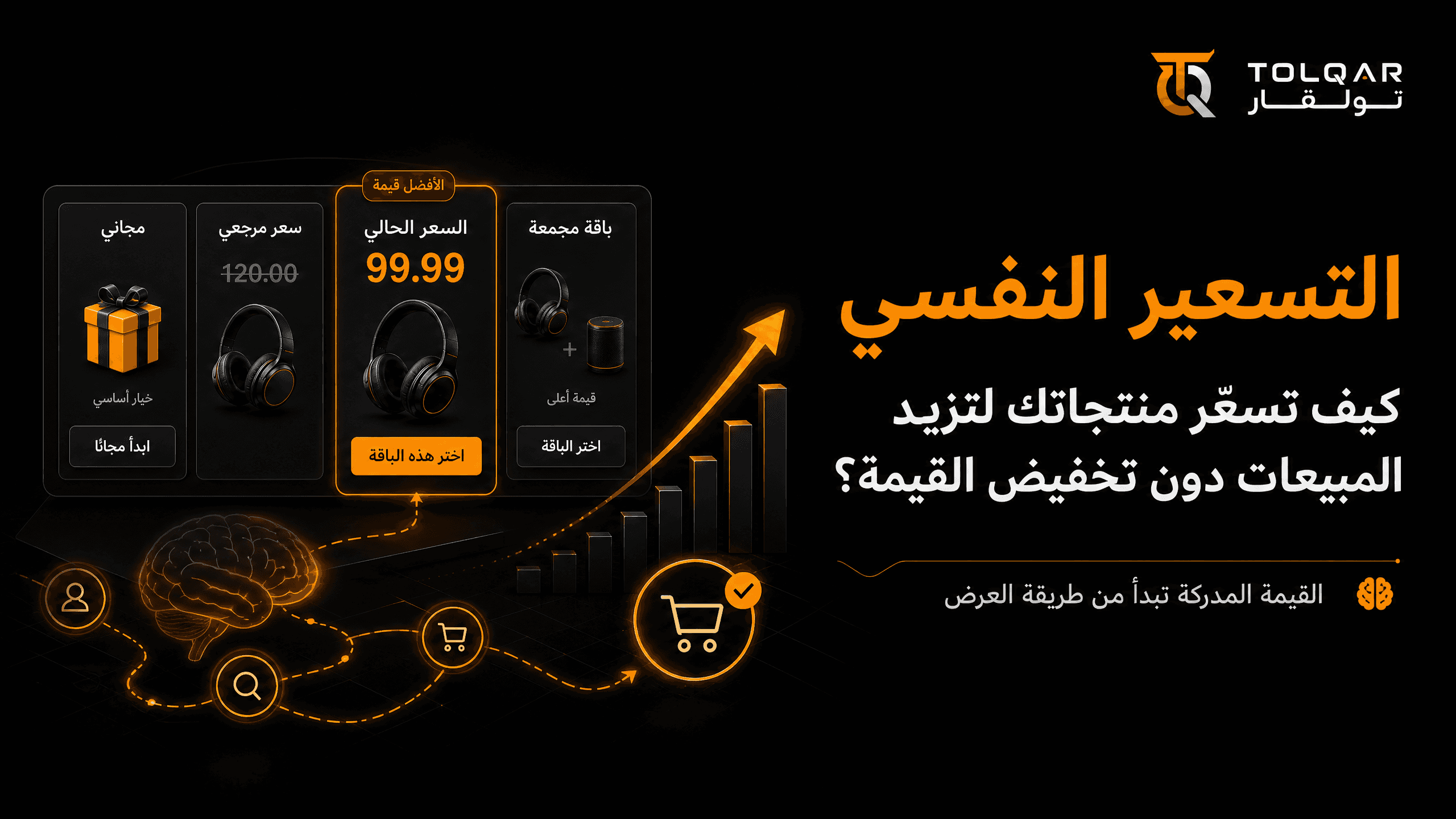
Research from the University of Chicago confirmed that pricing ending in 0.99 increases conversion rates by 8% to 12% for products under approximately $100. However, this effect weakens with luxury products, where clean pricing (without fractions) gives a higher impression of quality and confidence instead of over-promotion.
Strategy 2: Price Anchoring
Displaying a higher reference price next to the actual price (like "Was 150, Now 99") makes the current offer look like a much better deal, because the human mind relies heavily on the first number it sees as a reference to judge the rest of the prices.
Honest anchoring relies on an actually real reference — using a fake "previous" price that is not real harms customer trust in the long run if they discover its inaccuracy.
Strategy 3: The Decoy Effect
Adding a third option intentionally designed to be less attractive makes one of the other two options look like an excellent deal in comparison. Dan Ariely's famous research at MIT proved that adding a "print only" option at the same price as "print and digital" raised the selection of the targeted option from 32% to approximately 84%.
Strategy 4: The "Free" Effect (Zero Price Effect)
Dan Ariely's research proved that the psychological difference between "free" and one dollar is much larger than the logical difference between them. More than 66% of online shoppers expect free shipping, and about 48% abandon their shopping cart when they discover unexpected shipping costs at checkout. This makes free shipping (even if built into the product price itself) one of the most powerful pricing tools available.
Strategy 5: Bundling
Bundling multiple products at a single total price reduces the customer's ability to compare each item individually, and raises the perceived value of the offer as a whole, especially if the bundle solves a complete problem for the customer instead of selling them a single separate piece.
Strategy 6: Thoughtful Dynamic Pricing
Automatically adjusting prices based on demand, inventory levels, or time allows you to optimize margins without continuous manual intervention. This requires a technical infrastructure that supports automatic adjustment within rules and margins that you predefine.
Table: Which strategy fits which product type?
| Strategy | Best Suited For | Important Warning |
|---|---|---|
| Charm Pricing (0.99) | Economic and mid-priced products | Its effect weakens with luxury products |
| Price Anchoring | Seasonal offers and discounts | The reference price must be real |
| Decoy Effect | Multi-tier packages and subscriptions | Needs careful testing before full implementation |
| Free Shipping | Physical product stores | Calculate the cost within the profit margin beforehand |
| Bundling | Complementary products | Most effective if it solves an integrated problem for the customer |
| Dynamic Pricing | Stores with high sales volume | Requires technical infrastructure and clear rules in advance |
Important Warning: Psychological Pricing is a Scalpel, Not a Hammer
Using urgency tactics (like "limited quantity") excessively and repeatedly may boost short-term sales, but it also increases return rates resulting from impulse buying, and damages brand trust in the long run. The golden rule: monitor the return rate and customer reviews, not just the conversion rate, to ensure your growth doesn't come at the expense of your customers' loyalty.
How to Test Any Strategy Before Implementing It Fully?
Do not apply any pricing modification to your entire store all at once. Test it (A/B Testing) on a portion of visitors first, and measure the impact on the conversion rate, average order value, and total revenue per visitor, not just the conversion rate alone. Run the test for a sufficient period (at least two sales cycles) before making a final decision.
How We Help at TOLQAR in Designing a Smart Pricing Structure?
As part of our E-commerce Store Development service, we design a flexible pricing display system that supports bundling, conditional discounts, and displaying reference prices professionally and honestly, instead of relying on random numbers without a strategy behind them.
Frequently Asked Questions
Is psychological pricing a form of deception?
Not necessarily, as long as it is used with transparency and honesty (such as an actually real reference price). The problem only occurs when it is used in a misleading way that deceives the customer with untruthful information.
Should I apply all these strategies at once?
No, start with one or two strategies that suit the nature of your product, and test them carefully before gradually adding other strategies.
How do I know if the pricing strategy is harming my customers' trust?
Monitor the return rate, customer reviews, and repeat purchase rate after any pricing adjustment — a decline in these indicators is a warning sign even if the short-term conversion rate increases.
Conclusion
Smart pricing doesn't mean lowering prices to attract more sales — it means understanding how the customer perceives value, and using this understanding honestly and thoughtfully. The difference between a store achieving healthy margins and a store draining itself with continuous discounts usually lies in understanding these principles, not necessarily in having a better product.
Next Step
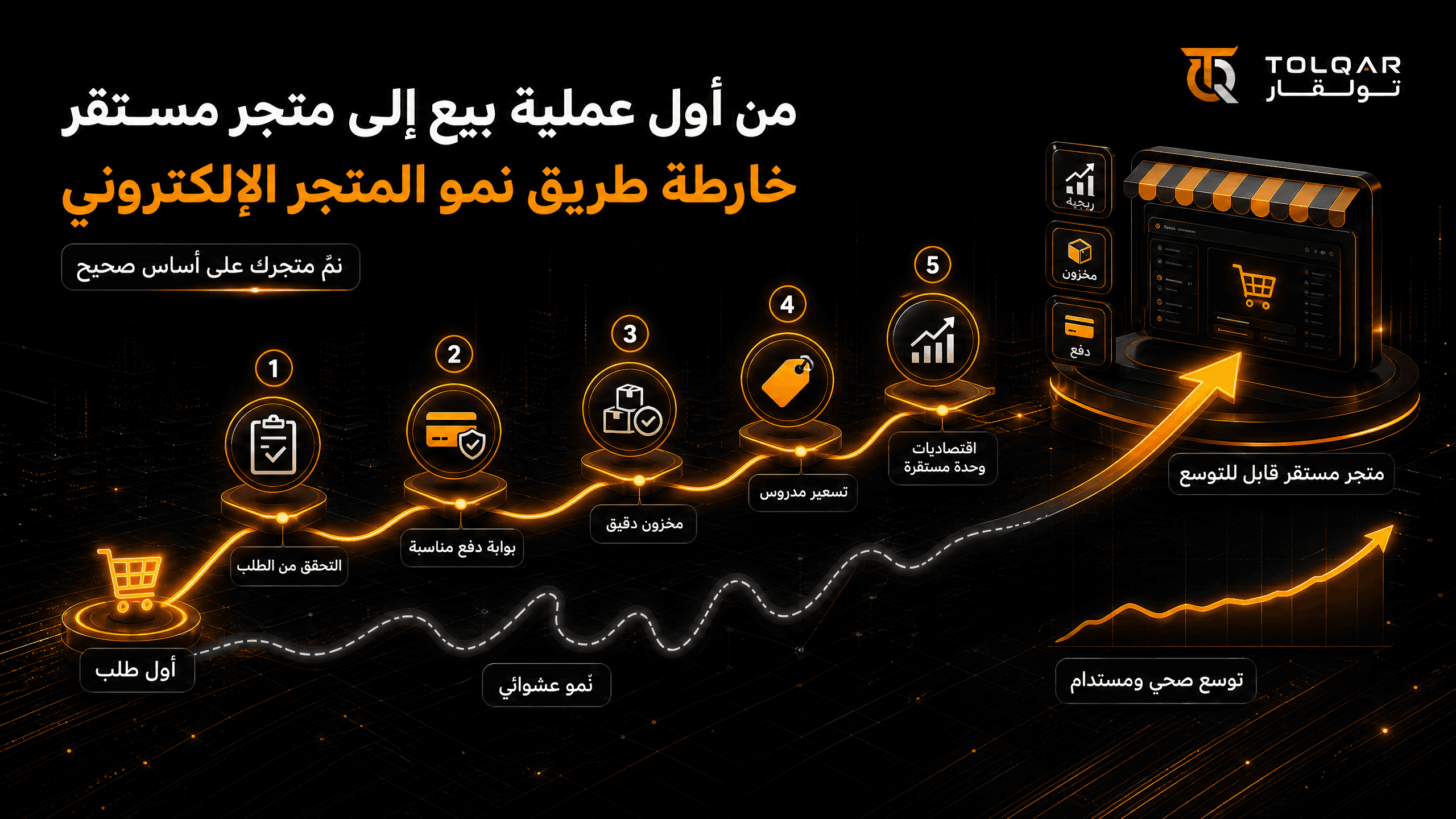
After covering the idea, product building, gateway selection, inventory management, and smart pricing, we have reached the final article in the series: a comprehensive roadmap from the first sale to a stable, continuously growing store. Read our latest article: From First Sale to Stable Store: The E-commerce Store Growth Roadmap.
Ready to build an online store with a well-thought-out pricing structure from day one? Browse our e-commerce development service at TOLQAR and get started with a pricing architecture that serves your true growth.