How do you manage your e-commerce store inventory without errors or sudden stockouts?
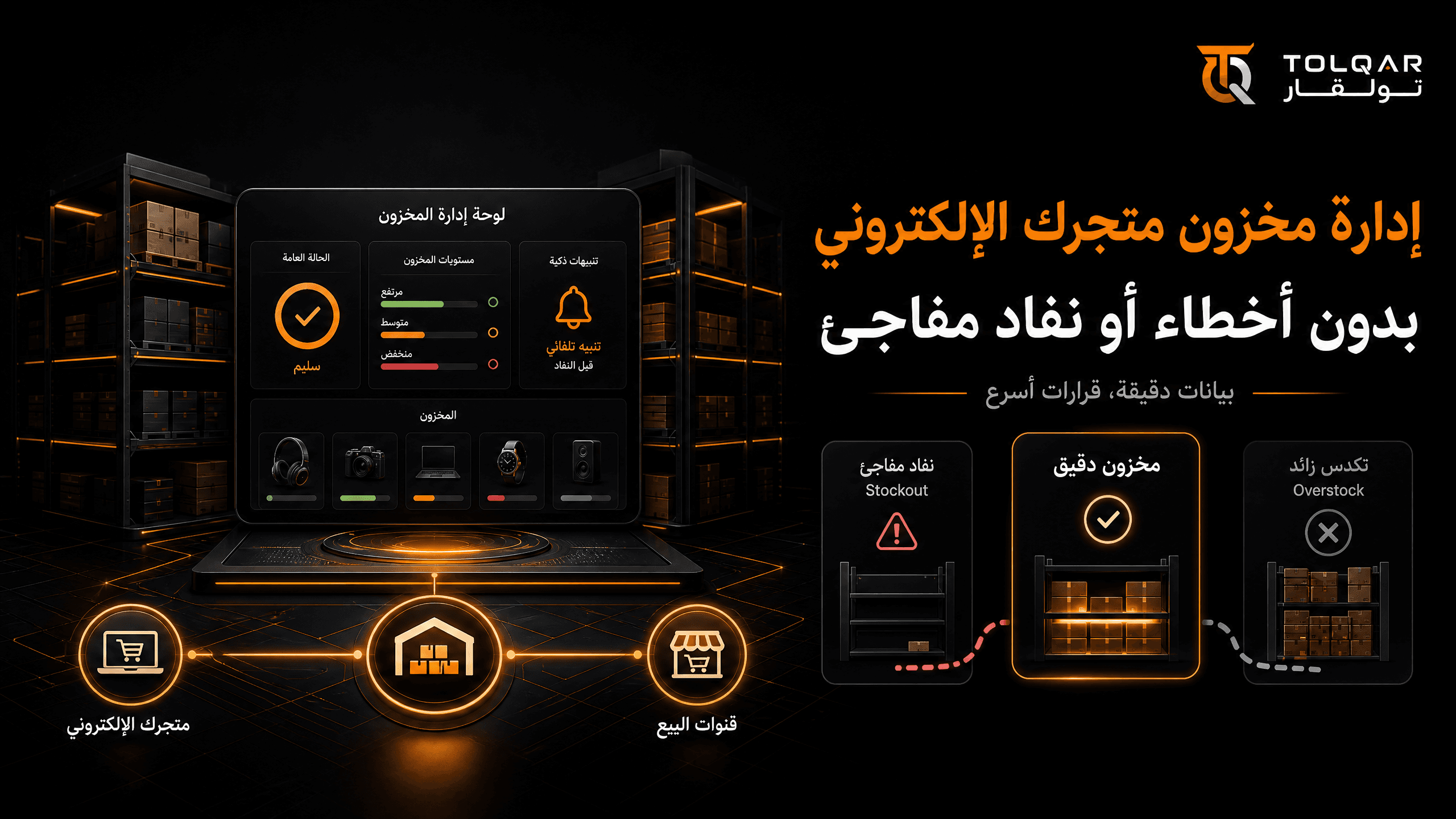
How to manage your online store inventory without errors or sudden stockouts?
Global estimates by IHL Group put the cost of poor inventory management (between sudden stockouts and dead stock) at more than $1.7 trillion annually across global retail. At TOLQAR, we build inventory management systems within every e-commerce store we develop, and this guide summarizes how to avoid these costly mistakes from the start.
The problem is bigger than most store owners imagine
Inventory Distortion happens when what is recorded in the system differs from what is actually available for sale. A large portion of this loss (about two-thirds) comes from stockouts, and the rest from the cost of holding unsold overstock.
A sudden stockout does not mean losing just a single sale — it often means losing the customer entirely, as they move to another competitor and do not easily return.
The root cause: A fragmented or inaccurate tracking system
Most inventory problems do not happen due to bad intentions or neglect, but rather because of separate tracking systems that do not talk to each other. If you sell through more than one channel (your website, a marketplace, a physical store), and each channel reads a separate inventory balance that is not updated in real-time, a gap occurs between what appears in the system and what is actually on the shelf.
5 essential practices for accurate inventory management
First practice: A single source of truth
All your sales channels must read from the same central database, not separate copies updated manually. This prevents the scenario of "the product appears available on the website, but is actually out of stock in the warehouse."
Second practice: Automatic alerts before a stockout, not after
Instead of discovering that a product is out of stock when a customer complains, a good system automatically alerts you when inventory approaches a pre-defined minimum threshold, giving you enough time to reorder before an actual stockout.
Third practice: Monitor dead stock with the same seriousness as stockouts
A large part of your capital may be tied up in products that have not sold for a long time. Set a time period (for example, 90 days without sales) as an automatic warning signal that prompts you to review the price or clear out this stock before it accumulates further.
Fourth practice: Separate "recorded balance" from "actually sellable balance"
The inventory balance recorded in the system may include reserved, damaged, or inspecting quantities. A good system differentiates between these cases, so that a balance that appears available is not shown to the customer while part of it is actually unsellable.
Fifth practice: Tie purchasing decisions to data, not intuition
Relying on the store owner's "gut feeling" about upcoming order quantities usually leads to one of two extremes: sudden stockouts or overstocking. Relying on actual sales data and historical trends provides much more accurate reordering decisions.
Table: Early warning signs
| Sign | What it means | Required action |
|---|---|---|
| Product approaching minimum stock threshold | Imminent stockout within days | Immediate reorder or supplier alert |
| Product with no sales for 90 days | Stagnant stock tying up capital | Price review or clearance |
| Frequent discrepancy between recorded and actual balance | Flaw in the tracking system itself | Physical inventory count and review of entry points |
| The same product frequently runs out in a specific season | Seasonal pattern not factored into planning | Adjust order quantity according to the season |
Practical example illustrating the scale of financial impact
Imagine a store losing 150 orders per month due to a sudden stockout, with a profit margin of $35 per order. This alone translates to a direct loss of nearly $5,250 per month, without factoring in the cost of expedited shipping to compensate for the shortage or the impact of a negative customer experience on their return later. This example illustrates why investing in an accurate tracking system is quickly recovered compared to the cost of ignoring the problem.
How do we build inventory systems at TOLQAR?
Every e-commerce store we develop within the E-commerce Store Development service includes an inventory management system built on a single centralized database (no conflicting multiple copies), with automated alerts when any product approaches stockout. This means the store owner monitors their inventory status from a single dashboard, instead of navigating between separate spreadsheets or relying on memory.
Frequently asked questions
What should the minimum stock threshold be before reordering?
It depends on the product turnover rate and supplier lead time, but the general rule is that the minimum threshold should cover the expected lead time plus a simple safety margin to avoid any unexpected delays.
Is stagnant stock an actual loss even if it is not sold at a loss?
Yes, because the capital tied up in it could have been invested in higher-demand products, in addition to the ongoing storage cost for as long as it remains unsold.
Do I need a complex inventory management system even if my store is small?
No, the system must suit your current size, but the basic principles (unified data source, automated alerts) are worth implementing even in a small store to avoid problems early before they grow with expansion.
Conclusion
Inventory management is not a secondary administrative task, but a direct factor influencing your revenue and customer satisfaction. The gap between what is recorded and what is actually available widens silently until it turns into a major problem, whereas an accurate and smartly built tracking system from the beginning prevents this problem before it occurs.
Next step
After organizing your inventory accurately, the next question is: How do you price your products to increase sales without sacrificing their perceived value? We will cover this in our next article: Psychological Pricing: How to Price Your Products to Increase Sales Without Reducing Value?
Ready to build a store with an accurate inventory system from day one? Browse our e-commerce store development service at TOLQAR and avoid these costly mistakes from the start.