SEO for E-commerce Stores: How to Appear on Google's First Page in 2026?
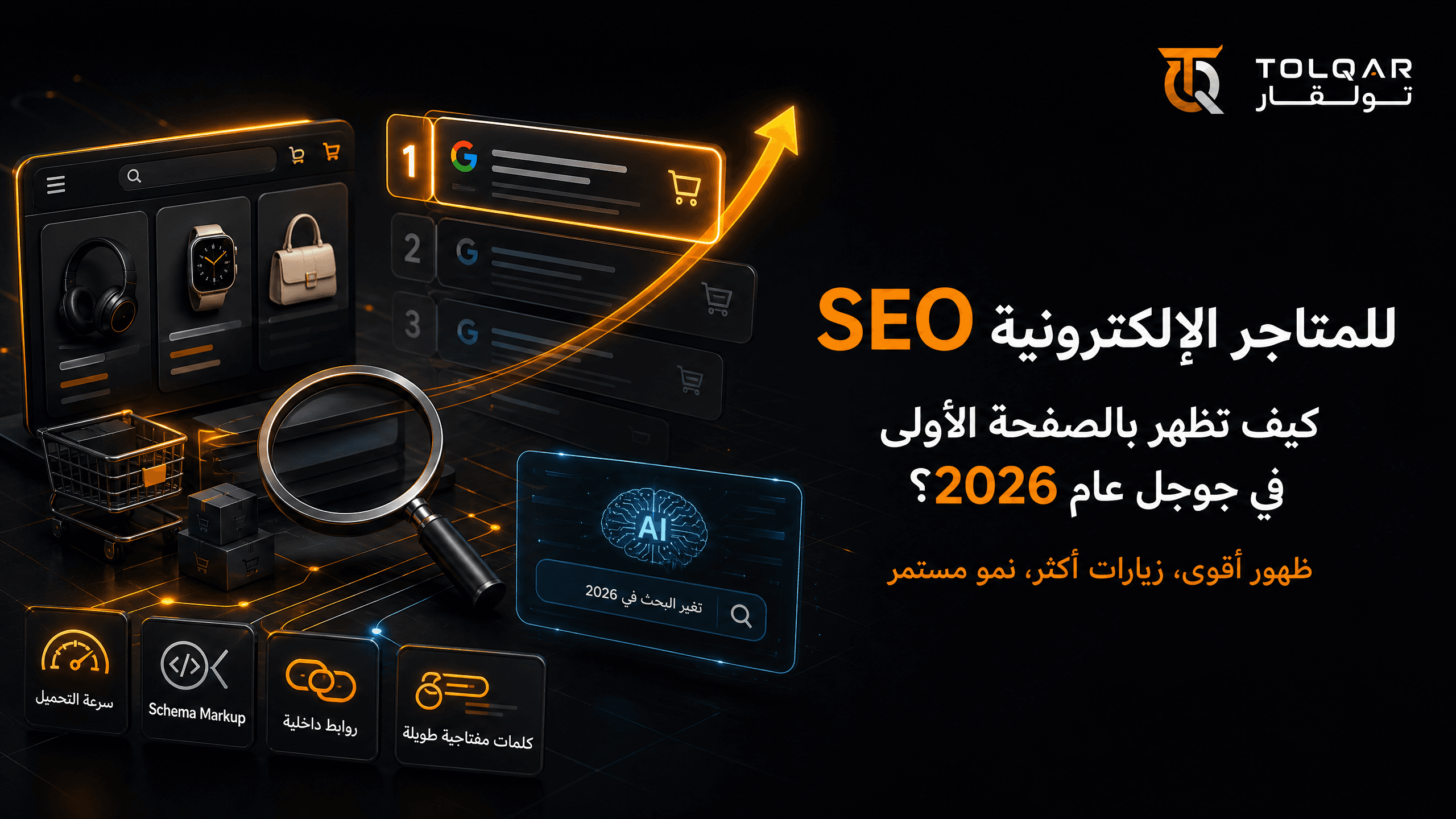
SEO for E-commerce Stores: How to Appear on Google's First Page in 2026?
Organic search alone drives 43% of e-commerce store traffic globally, and converts at a rate almost double that of paid ads — yet most store owners invest in ad budgets while neglecting the genuinely strongest channel. At TOLQAR, we build every store with a technical foundation that supports SEO from day one, and this guide summarizes how to actually benefit from this channel.
Why SEO is Much More Important Than Most Store Owners Think
The numbers are clear: organic search converts at a rate of around 2.8% compared to much weaker rates for most other channels, and the customer acquisition cost through it is significantly lower compared to paid ads. The most important difference: SEO returns compound over time, while paid ad results stop the moment spending on them stops.
SEO is not an immediate substitute for paid ads — it is a long-term investment that builds a digital asset continuing to bring visitors without a recurring cost per click.
The Big Shift Changing the Rules of the Game in 2026
This part is very important: the way people search is actually changing. More than 60% of shoppers now use artificial intelligence tools (like ChatGPT or Google's AI Overviews) as part of their buying journey, and about 69% of searches do not result in any actual click (because the answer appears directly on the page). This means that traditional SEO (just targeting keywords) is no longer enough on its own.
The positive point: Visitors who actually arrive via AI search are much more valuable — with a conversion value rate reaching over 4 times that of a regular visitor, because they arrive with a clearer and more specific purchase intent.
6 Essential Practices for Effective SEO on Your Store
Practice One: Site Speed is a Crucial Factor, Not a Secondary Detail
Stores that load within one second achieve a conversion rate more than double that of stores that load within 5 seconds. This is not a marginal difference — it is a doubled difference in revenue just for page load speed.
Practice Two: Product Pages Deserve Top Priority for Optimization
Product pages drive more than half of organic traffic, yet they achieve an even higher percentage of total conversions relative to their traffic volume. This means that optimizing a single product page carefully deserves more time than optimizing dozens of secondary pages.
Practice Three: Structured Data (Schema Markup) Increases Click-Through Rates
Pages equipped with structured data markup achieve a significantly higher click-through rate than regular pages, and Rich Results outperform standard results by a wide margin. This relatively simple technical improvement has a direct impact on your store's visibility.
Practice Four: Internal Links are Largely Neglected in Most Stores
A very large percentage of e-commerce stores lack an optimized internal linking structure, even among high-visibility sites. Linking product pages to relevant blog articles (just like we apply in our articles) distributes the "power" of the strongest pages to the rest of the site and improves Google's understanding of your store's structure as a whole.
Practice Five: Long-Tail Keywords Convert Better
Long, specific keywords convert at a much higher rate than short, general ones. Instead of targeting the generic "sports shoes" (extremely high competition), target "large size asphalt running sports shoes" — less competition and clearer buying intent.
Practice 6: Building Entity Recognition
With the rise of AI search, winning is no longer just about ranking for a keyword — it's about building clear recognition as a trusted brand that AI itself mentions within its answers. Brands mentioned directly within AI summaries achieve a significantly higher click-through rate than unmentioned competitors.
Table: SEO Priorities by Stage
| Your Store Stage | First Priority | Why |
|---|---|---|
| New store (less than 6 months) | Site speed + sound basic structure | Technical foundation sets the ceiling for all subsequent optimization |
| Medium store (6-18 months) | Product page optimization + internal links | Greatest direct impact on conversion with least effort |
| Mature store (more than 18 months) | Long-term content + brand recognition building | Builds a defensive site against search algorithm fluctuations |
Common Mistake: Focusing Only on Page One in Traditional Google
The reality is that the gap between page one and page two on Google is huge — the vast majority of clicks go to page one only, and page two is almost ineffective for most commercial searches. But focusing solely on "#1 ranking" and ignoring visibility within AI summaries means missing out on a rapidly growing segment of high-value visitors.
How Do We Build SEO Within Every Store at TOLQAR?
Our E-commerce Store Development service builds the technical foundation for SEO from the start (loading speed, clean structure, structured data) instead of treating it later as a delayed fix. This saves you months of wasted time trying to optimize a site that wasn't built with an SEO mindset in the first place.
FAQ
How long does it take for SEO to start showing actual results?
Usually between 6 to 12 months for tangible results, but the return accumulates continuously thereafter without recurring costs for each visit.
Is SEO more important than paid ads?
It is not a complete alternative, but a strategic complement. Ads bring immediate results but stop when spending stops, while SEO builds a long-term asset. We will discuss this balance in detail in our next article in the series.
Does AI search threaten the importance of SEO?
It changes its form, not cancels it — winning now requires building recognition as a trusted brand mentioned within AI results, alongside traditional Google ranking.
Conclusion
SEO is not an isolated technical task, but a long-term investment that builds a digital asset continuing to bring customers at a decreasing cost over time. With search rules changing due to the rise of AI, the real opportunity for those who understand both sides (traditional SEO and brand recognition building) is greater than ever before.
Next Step
After building the SEO foundation, the following question is: which social media platforms truly deserve your time and budget investment? We will cover this in our next article: Social Media Marketing: Which One Truly Deserves Your Investment?
Ready to build a store with a strong SEO foundation from day one? Browse our e-commerce development service at TOLQAR and start with a technical architecture that supports your visibility in search engines.